
Poker bots are commonly thought to simply become smarter as time goes on. In fact, the greatest difference was not IQ. It began with their focus on learning, analyzing and reacting in real time with adaptive systems.
Poker bots are a testament to the progress of poker automation, behavioral modeling, and machine learning, and have revolutionized the way that today’s poker software works.
What’s new in Poker Bot Technology?
The technology of poker bots went from being programmed with specific rules to utilizing AI to analyze play, adjust strategies and handle vast amounts of data. Modern solutions are based on machine learning, predictive modeling and decision engines, unlike traditional poker bots.
How Poker Bot Technology has developed throughout the years?
The solution is very simple: poker bots are not only automated but they are also adaptive decision-making systems.
Early software was rule- and decision-tree based. The modern systems can analyze the behavior, process a lot of game data and even adjust the strategies dynamically. This is what has enabled the evolution of poker bot technology over the years and how it differs from its predecessors.
History of Poker Bots: The Beginning of Poker Bot Technology.
In the modern sense these systems were not intelligent. All they did was obey orders.
Early Rule Based Poker Bots
In the early days of poker bots, they used to be programmed with a fixed algorithm. Decision trees were developed by the developers that would determine when to fold, call or raise on the basis of limited conditions.
Typically these types of bots were employed:
- Fixed hand-strength thresholds.
- Basic probability calculations.
- Predefined betting actions.
- Simple conditional statements (if-then statements).
They wanted to be consistent and thus they were against adaptation.
Poker Bot Software was created.
The first generation of poker bot software was more advanced as the game of online poker grew. The introduction of statistical tracking and bigger rule libraries came in.
But these still lacked awareness. They could execute instructions but did not learn from results, and/or recognize changing player tendencies.
So, why are there today’s bots for poker?
As the competition in online poker grew, more advanced poker analysis models were created.
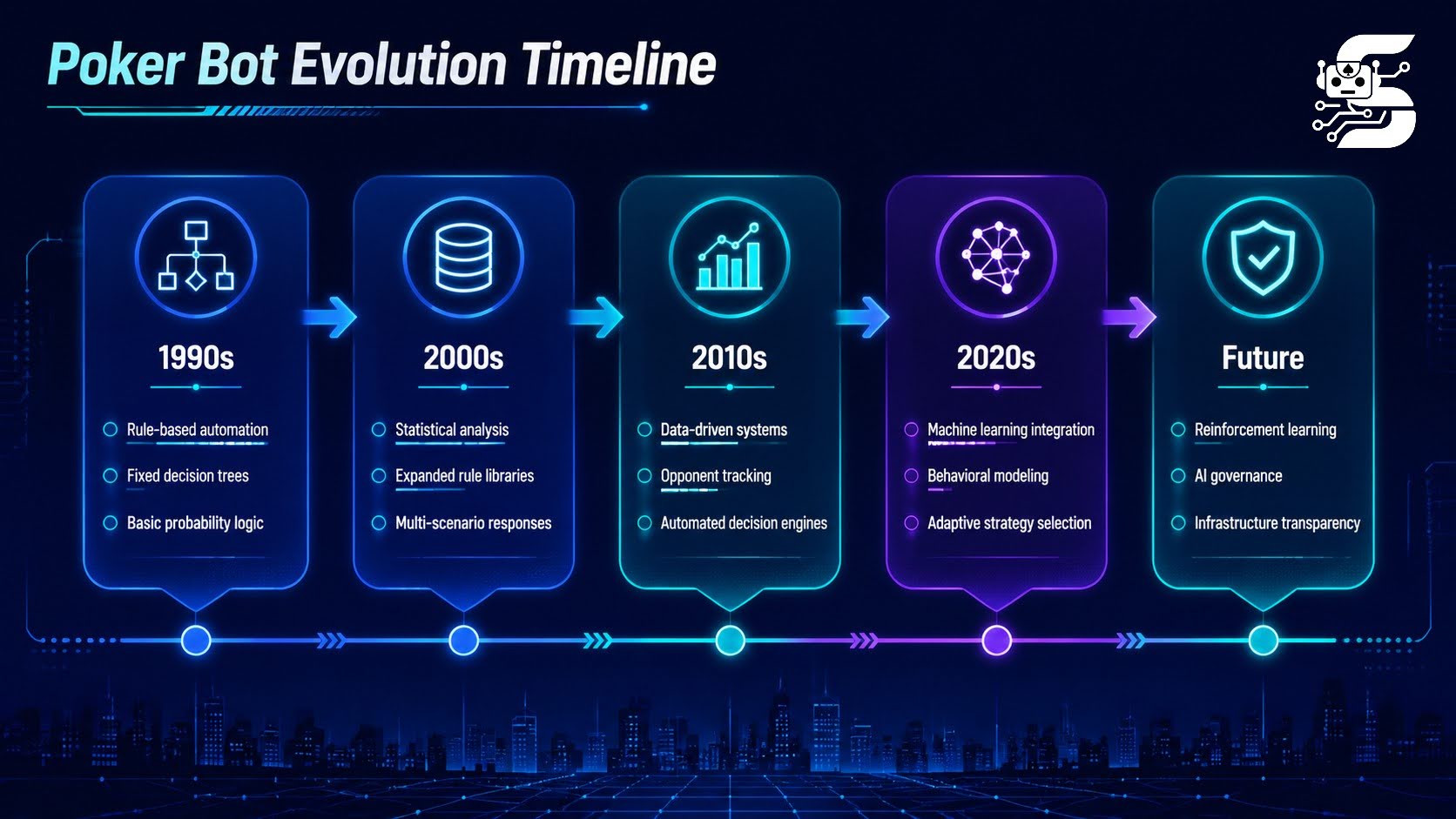
There were several phases of the development of poker bots:
- Rule-based automation.
- Statistical analysis systems.
- Data-driven decision engines.
- Machine learning integration.
- AI-enhanced adaptive systems.
As the power of the computers grew, poker automation became more powerful, and could process more data and identify more intricate patterns.
For what did AI’s turning point came about?
Previously, instructions were performed by some systems. AI systems process scenarios, work out the odds and adjust the answer to the new information.
You should ask: “Why is the Evolution of Poker Bots so BIG a deal?
There was more technology but not so much as to be sophisticated. The most difficult aspect was adapting. Could a system evolve to play different opponents and game-play without needing to be specifically programmed?
AI Poker Bot Technology has revolutionized the world of online poker
AI revolutionized poker bots with the introduction of decision-making frameworks that adapt to different scenarios.

Machine learning added to the skill set the pattern recognition, outcome assessment, and evolutionary improvement over time. Meanwhile, the progress of Game Theory Optimal (GTO) modelling had a significant impact on the way AI-powered poker bots made their decisions.
Key changes included:
- Behavioral analysis
- Dynamic strategy adjustment
- Predictive modeling
- Real-time data processing
- Continuous optimization
Modern systems will be able to consider several factors before they take an action, instead of the same action over and over again.
It marked the turning point of the AI poker bots’ evolution.
In this lesson, students will learn to compare and contrast an old and modern poker bot.
Poker bots of the past were based on a set of rules and had a narrow amount of data entered.
Old Poker Bots vs Modern AI Poker Bots
The classic poker bots are no longer relevant with the emergence of modern poker bots. The main difference between the old poker bots and modern AI poker bots is their adaptability.
Older systems were instructed. Modern systems make assessments about information.
|
Feature |
Early Poker Bots | Modern AI Poker Bots |
| Core Logic | Fixed Rules |
Adaptive Models |
| Learning Ability | None |
Continuous Optimization |
|
Opponent Analysis |
Limited | Behavioral Modeling |
|
Strategy Changes |
Static |
Dynamic |
| Data Usage | Small Inputs |
Large Data Sets |
|
Decision Process |
Predefined |
Context-Aware |
The comparison shows the differences and why poker bots today are a completely different generation of technology as compared to those of the past.
As AI becomes more sophisticated, however, it raises additional challenges on the topics of AI governance, systems of integrity of behavior and fairness. The more you can do, the more complicated it will be.
What is Advanced Poker Bot Software Nowadays?
The contemporary poker bots are not based on a single decision engine, but on multiple layers of analyses. Behavioral analysis is all about recognising trends and patterns in player actions.
This information can be used for creating profiles in context, not just observation profiles. The use of predictive modeling and AI algorithms.
The machine learning models use previous outcomes and the real-time information from the games to forecast potential scenarios in a game. The system is based on a question that is “What is most likely happening here?” instead of “What should I do here?
What Does Automated Poker Strategy Execution Mean?
Automated poker strategy execution involves transforming the analytical insights into action.
The implementation of the strategy automatically.
A modern execution framework is composed of the following steps: Collecting game data, analyzing context, calculating probabilities, choosing a strategic response and then executing an action.
All of this results in a full fledged decision pipeline from observation to evaluation to execution.
This is one of the most important innovations in the realm of poker automation technology that is in operation. Regardless of a person’s intellectual prowess, they need to have good governance skills as well.
With the development of poker AI, transparency is increasingly sought and the need for fairness systems and AI governance to ensure the integrity of poker is also growing. The measure of future innovation will be its performance and not its capability.
What lies ahead for poker bot technology and AI poker bots?
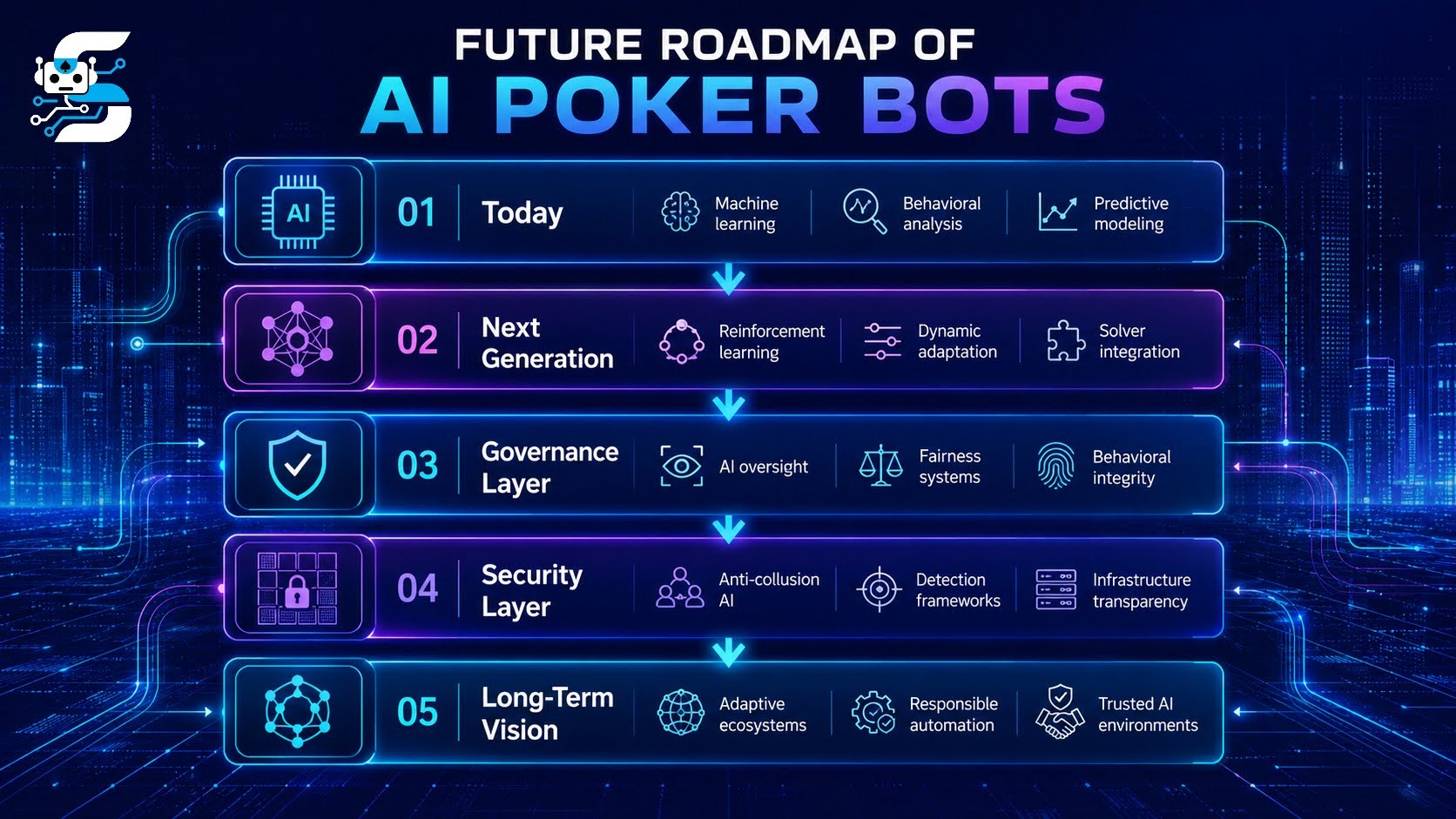
Future developments in poker bot technology could involve enhanced machine learning capabilities, improved behavioral modelling, and improved regulation.
Some of the most prominent trends that are coming into the picture are reinforcement learning systems, better decision engines, advanced simulation environments, increased transparency of infrastructure and better fairness controls.
As the poker AI systems become more sophisticated, the security, integrity, and oversight of players will become even more important.
It’s likely that the next big thing in poker bots will be more accountability than intelligence.
Key Takeaways From the Evolution of Poker Bot Technology
These were the main points that were accomplished:
- Rule-based decision systems
- Statistical analysis frameworks
- Machine learning integration
- Behavioral modeling
- Adaptive decision-making AI systems.AI systems that take adaptive decisions.

Gaining the understanding of the evolution of poker bots gives you an insight into the relationship between automation, artificial intelligence and strategic decision making in general.
Further Reading
External Sources
- Association of Certified Gaming Compliance Specialists: Governance, compliance and responsible gaming structures.
- This course is an introduction to the foundations of machine learning, adaptive decision systems and predictive modeling.
- A simple explanation of the core concepts behind the optimization of modern poker strategy, using game theory.
Rare Terms Only: Words that are rarely used.
- Reinforcement Learning: Machine Learning that is learning by doing.
- Behavioral Modeling: Identifying patterns and tendencies, and predicting future behavior.
- Decision Engine: The system element that determines the action(s) to take based upon the information available.
- GTO Modeling: Strategy development using game theory principles that aim to decrease the exploitability.
Infrastructure Transparency: The transparency of systems’ operation, decision making and governance.