

In 2026, most poker bot bans are no longer based on the recognition of a blatant mistake in the poker bot. The number of predefined actions is reducing, but the number of detection systems is growing and now, it is more common to find detection systems searching for behavioral consistency, interaction patterns and infrastructure fingerprints.
Poker bots and systems are still detectable in 2026 using AI. Platforms have been rolling out more and more behavioral analytics, machine learning models, device fingerprinting and anti-collusion systems to assist in the detection of shady play. Detection is not about signature-based detection, it’s about integrity of behavior over time.
AI poker bot detection is the ability to find poker bots or AI-assisted betting by watching players, using ML systems, by device fingerprinting and by creating anti-collusion infrastructure, not by scanning for simple code.
If there are statistically unlikely patterns and/or inconsistencies in how a poker bot plays the game, then the poker bot is easily detectable.
The basic change is an architectural one: early systems are designed for scripted behavior, today’s systems are designed to be part of larger fairness systems, which are based on integrity of behavior, trust and consistency of the system.
Important Disclaimer:
SmartPokerRobot is provided strictly for educational, analytical, and poker strategy research purposes. Discussions of bot detection, behavioral analysis, and security systems are intended to explain the technology and fair-play challenges surrounding AI in poker, not to encourage cheating or methods for avoiding detection. Our technology is intended exclusively for free-to-play games, simulations, and practice or training environments, and should not be used to automate real-money gameplay, circumvent security measures, or violate platform rules and fair-play policies.
Why is it that AI Poker Bots can still be identified in 2026?
Older scripted poker bots were relatively easy to detect because they followed fixed rule sets. These rule-based systems often produced consistent and predictable behaviors, which made them vulnerable to traditional detection methods.
However, modern poker bots no longer rely on rigid rule trees in the same way. Instead, detection has shifted toward analyzing the environment in which a player operates, along with long-term behavioral patterns and statistical inconsistencies.
For a deeper understanding of this evolution, you can read: How Poker Bot Technology Has Changed Over Time
Today’s systems are far more adaptive. They are often built on decision models influenced by game context, GTO-based logic, and semi-manual assistance layers. In many cases, they resemble decision-support systems more than fully automated bots.
At the same time, online poker operators have significantly increased investment in detection infrastructure. Modern poker security is now part of a broader ecosystem that includes:
- anti-collusion systems
- fraud detection frameworks
- KYC verification processes
- liquidity protection systems
- player integrity monitoring
This creates an ongoing escalation cycle between automation sophistication and detection sophistication.
Instead of focusing only on individual actions, modern detection systems evaluate behavioral integrity across entire sessions and long-term gameplay patterns.
Why Can Poker Bots Be Detected?
When the timing of the game, the activity of the device or the way in which the game is being played is not in line with the expected variance in human gameplay, the bots are flagged.
There are still some signals which are rather straightforward.
The amount of re-spins and number of sessions played.

Without a degree in poker, you can’t get a consistent poker player. The player, regardless of his or her strength, may be slightly off target when tired, emotionally upset, during a time of transition at the table or when the player’s focus or concentration may shift.
Automated systems do not necessarily have the ability to create that entropy again.
Some of the most common patterns of poker bots are:
- Size of bets that are very repetitive,
- A fixed time period to make decisions, which is statistically calculated, and
- unrealistic multi-table scaling,
- and very long continuous playtimes!
If a player is multi-tabling 12 tables and has a very consistent attention span over the course of hours, that player will have a different behavioral signature than a human grinder with a varying attention span, distractions and decision making times. These differences are compared in detection systems, which are applied to large quantities of data, rather than to an individual hand.
How to track a mouse to identify a device?
Some platforms also evaluate the surroundings of the VPN, virtualization systems, anti-collusion AI alerts and risk scoring models for coordinated automation ecosystems throughout multiple accounts.
Today, more than just the moves that can be tracked by poker bots.
As poker sites become more sophisticated, they are getting better at analyzing:
- cursor movement entropy,
- click acceleration patterns,
- input timing variability,
- hardware signatures,
- operating environments,
- and the interaction layers of and software.
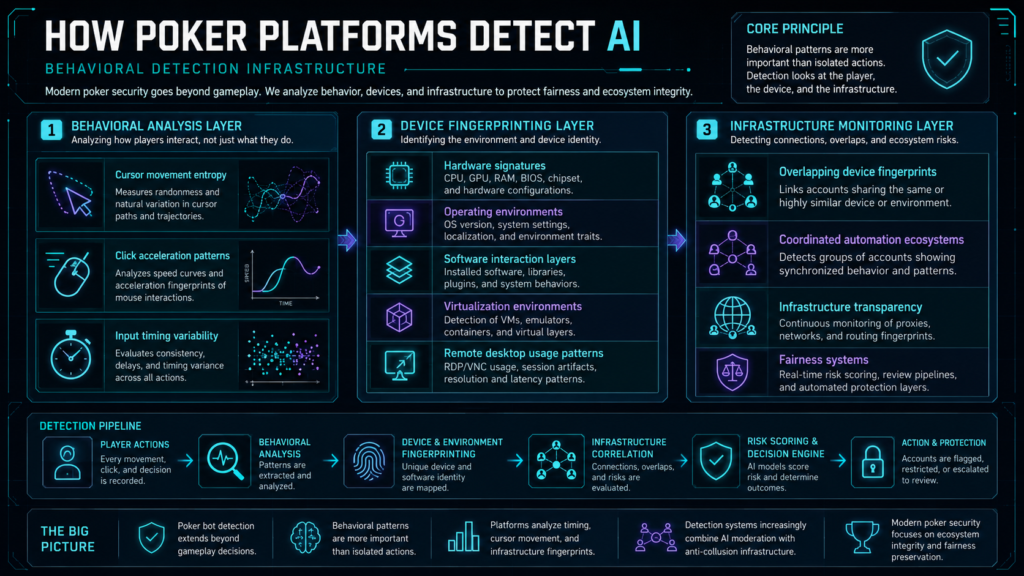
Other systems can track virtualization activity rather than just the one suspicious session, and can be configured to detect the activity of a coordinated automation network on an account-by-account basis.
It’s simply the newest step in a line of initiatives to enhance infrastructure visibility as a way of fairness and retention in the poker area.
What are the ways poker websites are able to identify AI poker bots?
The use of behavioral modelling systems for identifying bots has increased at poker sites, as well as software signatures.

In other words, a multiple-layered detection system is provided in practice, rather than a single-layered detection system.
The machine learning detection models are provided:
The models for behavioral detection are now more like anomaly-scoring models. Platforms aren’t just searching for known bots, but if players act in a similar manner as humans on a statistical scale.
| Traditional Detection | Modern Detection |
|---|---|
| Static software scans | Behavioral AI models |
| Signature matching | Risk correlation systems |
| Isolated account reviews | Ecosystem-wide analysis |
| Simple automation flags | Long-term behavioral modeling |
| Manual software checks | Multi-layer anomaly detection |
This is an important difference between the gameplay and detection AI.
| Detection Layer | Primary Function |
|---|---|
| Behavioral profiling | Tracks timing, betting, and interaction consistency |
| Risk scoring systems | Flags unusual statistical patterns |
| Device fingerprinting | Identifies repeated infrastructure environments |
| Software monitoring | Detects unauthorized overlays or automation tools |
| Manual security review | Confirms suspicious cases through investigation |
Nowadays, poker AI software will attempt to make the optimum choice. Detection infrastructure tries to simulate the variability among humans and detect deviations from the expected behavior of the players. The two systems develop and diverge more and more.
There are also some operators that have AI capabilities that can detect collusion, like:
- coordinated betting behavior,
- In an unusual flow pattern of the chips, and
- synchronized session activity,
- and player tampering.
Such systems are significant in particular in high volume liquidity trust systems, in which the maintenance of liquidity trust is crucial for the operating of the system.
The security teams and security software monitoring
There will be a huge amount of human investigation, as well as machine learning moderating the content.
The majority of the big poker ecosystems have automated flagging systems, and manual reviews by security teams. These reviews could contain:
- hand history analysis,
- session pattern investigation,
- software environment verification,
- and account linkage analysis.
What’s important is that current poker bot detection techniques are not always based on just a single indicator. Typically, detection will be the result of a series of behavioral indicators that have been collected over a period of time.
It’s in line with the overall compliance environments and conducts integrity policies within online gaming systems.
How to make AI Poker systems more difficult to find?
The first bots that had been scripted were not flexible, had a very short time window and performed the same after a certain number of samples.
Investment in surveillance, compliance and behavioral security infrastructure by operators have followed suit as AI systems have developed.
The humanized Timing and Adaptive Play Styles are also available:
Numerous AI poker websites have incorporated the following characteristics:
- variable response timing,
- dynamic bet-sizing distributions,
- contextual aggression shifts,
- Randomization decision weighting and.
Some more sophisticated systems have the ability to permit some degree of irregularity in behavior with an intentional purpose to do so at each hand.
This diminishes the effectiveness of the detection methods which are simple.
Semi-manual Operations with AI Systems:
One of the new categories of tools are not automatic, but semi-automatic, which are based on suggestions from humans.
While it doesn’t seem like an AI poker assistant is automated, it can still be inconsistent from one moment to the next, which can be identified.
In these environments:
- interaction is still under the control of the human,
- the software gives strategic suggestions,
- The impact of their work and their effects are not as visible as with fully automated bots.
This can be a challenging detection situation, with people and their random movements, and AI optimization. The tension is never resolved: As AI technology advances, more and more investment goes into the platforms to enhance their security, anti-collusion, adaptive detection and other behavioral security features. No balance/equilibrium between automation and enforcement.
What Raises the Threat of Ban on Poker BOT?
High level of automation, volume of play, obsolete software environments and shared infrastructure fingerprints have a significant impact on detection and ban risk.

In reality, most poker bot bans are not a single event, but are the result of an operation.
High-Risk Automation Behaviors
There are some patterns that are found repeatedly that can enhance detection pressure:
- no natural variability over prolonged period of grinding (multi-hours),
- fully-automated interaction workflows, and
- the coordination of action from several accounts,
- predictable timing structures,
- and an over-scaling of players across pools.
Linkage risks can also exist between accounts running in the same automation ecosystem, due to shared VPS infrastructure or repeated device fingerprints can also cause linkage risks between accounts running in the same automation ecosystem.
Large enough sample sizes can eventually yield recognizable statistical patterns even for the most sophisticated AI systems.
Compliance with legal and ethical standards when using AI poker systems:
At the moment, it is uncertain what the legal consequences of the usage of AI in poker will be, however, most poker websites have rules in their terms and conditions against the use of automation and cheating throughout a real-time game.
As the poker bot has been introduced more and more claims are being made that these can’t be detected, which is in conflict with today’s behavioral monitoring systems.
The highly developed poker ecosystem has been implementing behavioral monitoring as an integral component of its holistic approach to protect liquidity and fairness as the number of players keeps growing and the level of competition intensifies.
This is important as it will impact how the organization will operate.
While some tools fit into the grey zone in between, there are others that do not:
- training software,
- decision-support systems,
- HUD environments,
- and to regulate the automation system.
The key point is the platform doesn’t have to determine which type of tools are going to be used, but the fairness is maintained. A competitive liquidity market has at its core behavioral integrity and trust in the markets is long term.
They are now being used in enterprise poker systems and other related applications such as behavioral analytics, anti-collusion, AI assistant systems, real-time monitoring, and more.
Key Takeaways
- The new trend is behavioral analysis, instead of software signatures, for detecting poker bots.
- The AI assisted systems are more sophisticated than scripted bots, but can be identified with patterns.
- A few of the fundamental security tools include machine learning moderation, device fingerprinting and anti-collusion systems.
- In terms of complexity of detection, AI tools with semi-manual are more complicated than fully automated bots.
- An accumulation of past behaviors, rather than one behavior, over time, is what is most important in most bans.
Further Reading
External Sources
- The Rules of the Gambling Commission are the rules that regulate online games, ensuring they are fair, compliant and regulated.
- The International Gaming Standards Association (IGA) is the source of gaming technology and interoperability standards.
- eCOGRA: Independent testing & gaming compliance frameworks.
- Gaming Laboratories International (GLI): Standards for certification, and gaming security testing.Â
Glossary:
- Behavioral Entropy: The amount of variation in human interaction (including click or betting).
- Device Fingerprinting: Technique of tracking the infrastructure using hardware, software and environment IDs.
- GTO (Game Theory Optimal): Strategy set that will be used to decrease exploitable patterns of gameplay.
- HUD: Software that appears on the screen that will provide the players’ statistics throughout a poker game.
- KYC: Know Your Customer’ identity verification process of gaming platforms.
- Risk Scoring System: computer-based model that provides an indication of the level of suspicion for behavior.
- Semi-Manual AI Assistance: AI systems which are augmented with human interaction for playing the game.
Understanding the concept of poker AI is crucial to break the myth of “bot vs humanâ€. Today’s online poker is on the verge of a behavioral modeling, security setup, AI control and trust in the ecosystem.
We here at the Smart Poker Robot ecosystem explore the evolution of adaptive systems, automation and fairness architectures in the modern online gaming environment.
FAQ
Can poker sites detect AI poker assistant tools?
Yes. When playing patterns, timing, and environments are inconsistent, AI tools can still be detected.
What are some indications of a poker bot?
Hard-coded timing, repetitive actions, high session volume, and infrastructure anomalies are common signs.
How do poker sites track poker bots?
They use behavioral analysis, machine learning systems, device fingerprinting, and manual reviews.
Is it legal to use an AI poker bot?
It depends on the platform, but most sites prohibit automation and real-time assistance.